A view from the FOC'SLE #16: GPS Use In the Maritime Industry
BLOG | March 2025
Firstly, a warm welcome to all hands from our lookout perch on the Foc’sle!
Christmas, New Year, and Chinese New Year are all now well astern, although the waters ahead look decidedly roiled at the moment!
In this edition, I would like to touch on some recent events concerning GPS.
Perhaps a reference to Masefield’s SEA FEVER may be in order here, although “the kick of the wheel and the white sail’s shaking” may not ring very much of a bell in the minds of the modern mariner, the “grey mist on the sea’s face, and a grey dawn breaking” might!
As I am sure all readers are well aware, GPS plays a very important part in the maritime industry. Not only in simple (??) electronic charts and positioning, but in a myriad of other functions, both seen and unseen, which we all take for granted. The GPS satellite constellation has been put in place and is maintained by the USA and is available free of charge to anyone with a suitable receiver. It is commonly capable of computing the position of the receiving antenna to within 1 meter accuracy, with very few areas in the world where coverage is not available.
There are two other satellite -based navigation systems, GLONASS run by Russia and BeiDou run by China. For our purposes, they are all much the same.
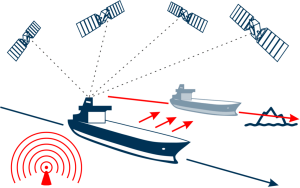
Some years ago, some of the less-reputable large fishing vessel owners started to experiment with ways that they could hide their vessels from official oversight. They came to the conclusion that it would be a good plan to be able to “adjust” their position as shown on GPS to show them operating legally. This trial and error “adjusting” of GPS signals became more widespread, and next there came reports of several large crude carrying tankers at anchor off Novorossiysk in the Black Sea where their GPS derived positions showed them as being parked on the airport runway some 50 miles away!
Illustration source: RiskIntelligence.eu
Things have now deteriorated further, to the point that GPS jamming or spoofing is common in the Baltic, and we have now seen the first “GPS assisted” grounding of a bulk carrier there.
Polish Government research has pinned the jamming as coming from “Dark Fleet” vessels at sea in the Baltic, presumably the ones not having an anchor dragging along the seabed.
The Royal Navy and UKMTO have recently reported that GPS jamming is taking place in the Hormuz Strait area, again emanating from a ship or ships at sea.
Further jamming has been reported in North China, although that seems to be on an experimental basis at the moment.
And now, one step further; bridge to bridge communications (via vhf radio) are also being jammed. By word of explanation, this communication is necessary for two ships to communicate collision avoidance manoeuvrers with each other.
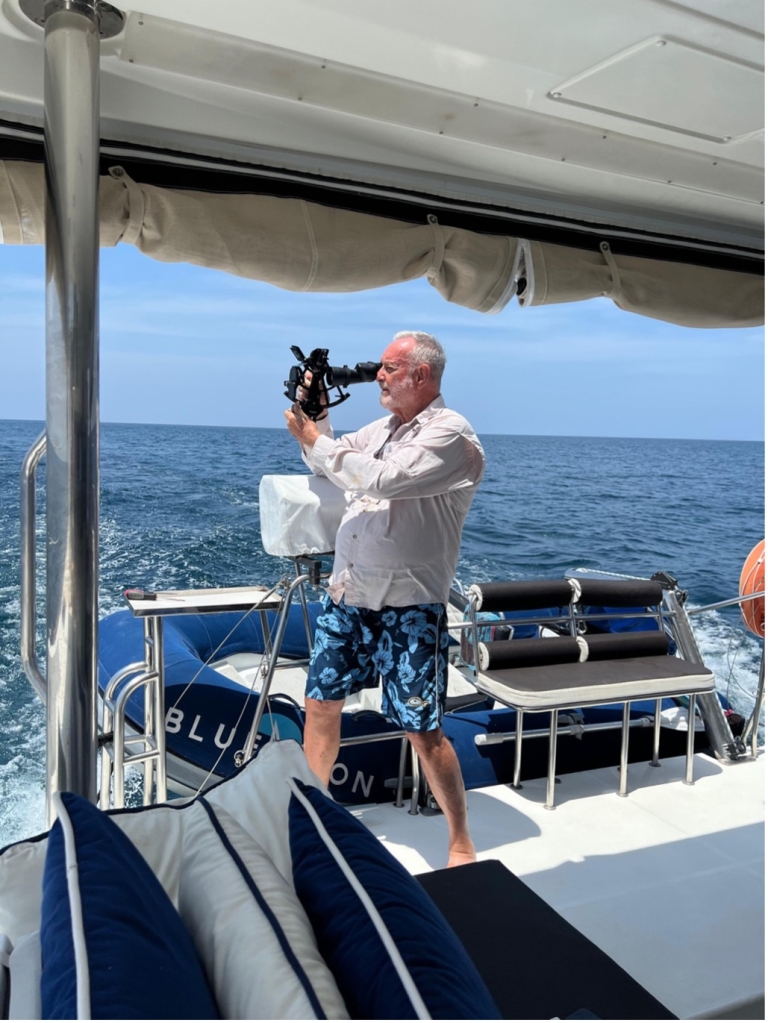
So perhaps this is where we need our modern mariner to hark back to Masefield’s time, to check the index error of their sextants, wind their chronometers every day, make sure that there is a current Nautical Almanac in the chartroom bookshelf and keep a record of compass error.
I would venture that less than 10% of ships at sea, of all shapes and sizes, diligently cross-check their positions by non-GPS derived means. At the risk of sounding like the village Parson, perhaps we should be encouraging crews to take visual bearings when in sight of land, shoot the old “Sun-run-sun” sights when out of sight of land and generally treat their GPS and ECDIS with the suspicion it now needs.
And on the subject of “dark fleets and shady deals,” let’s look at some shady flags in the next edition!
Until our next lookout watch on the Foc’sle,
Your Lookout Man
About The Lookout Man
Captain Jon Elliott
Capt. Jon began his seafaring career in 1960. He spent 11 Years in Taiwan running US Lines and then moved to Singapore in 1980 where he eventually joined Matthews Daniel in Singapore in 1989 and becoming Far East Managing Director. Capt. Jon started his own company Elliott Associates Pte Ltd after his retirement to bring an enhanced level of loss prevention to the Asian Marine industry. Capt. Jon is a consultant to Coastal Marine Asia Holdings Limited in our Loss Prevention Division providing technical guidance to our underwriters, whilst arranging crew and management loss prevention training for some of our insureds.
Disclaimer: The authors’ views expressed in this article are personal to him and do not reflect the views of Coastal Marine or any of its employees, unless explicitly stated. Data and charts, if used, in the article have been sourced from available information and have not been authenticated. The author and Coastal Marine make no representation as to the accuracy or completeness of any information in the article and we do not accept any responsibility for the same. This publication is provided as-is without warranty of any kind, either express or implied, including, but not limited to, the implied warranties of merchantability, fitness for a particular purpose, or non-infringement.